MOWAA Institute hosts inaugural seminar on West African archaeology
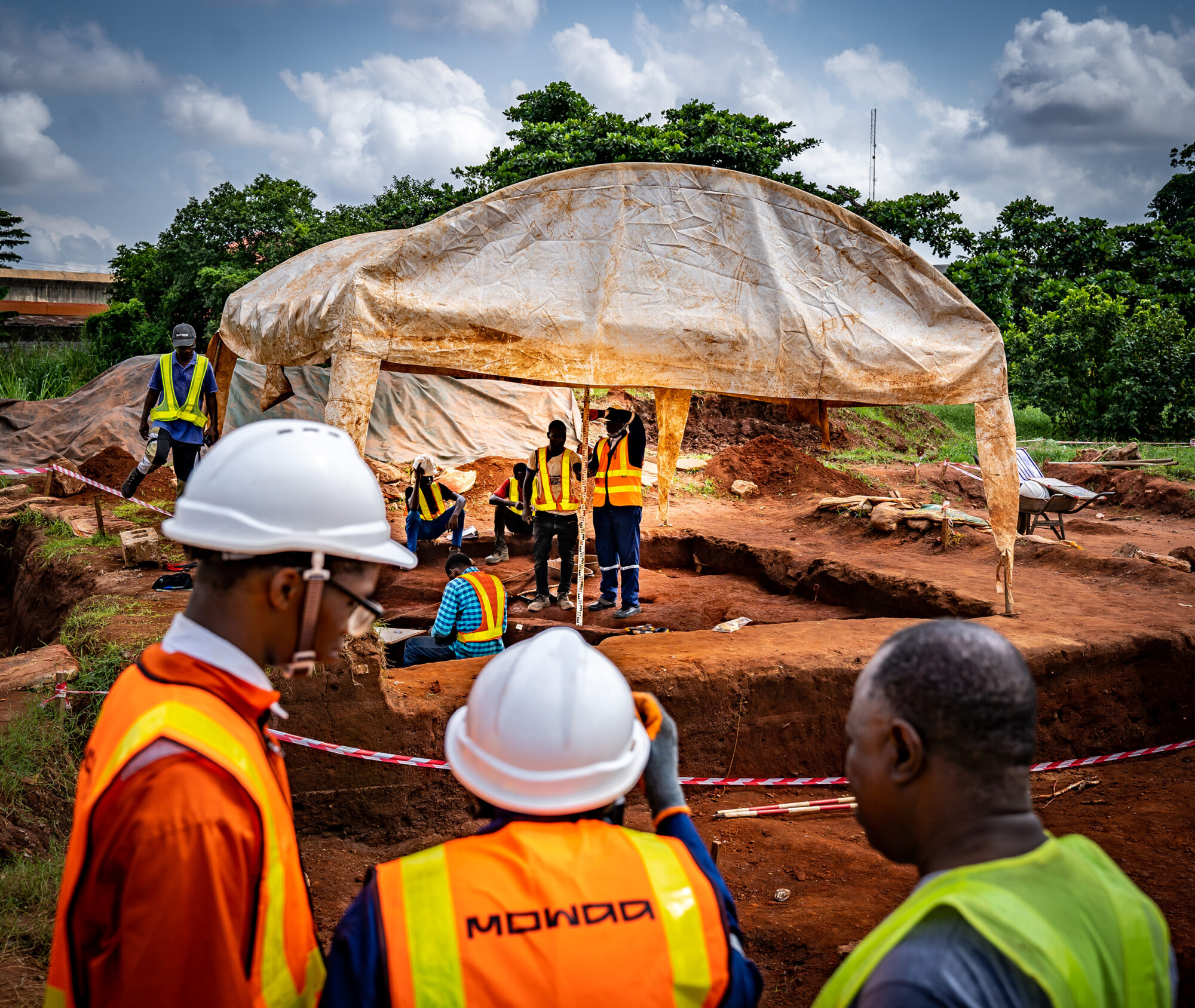
On September 12–13, 2023, MOWAA hosted leading West African archaeologists and heritage experts for the inaugural seminar, “Futures of Archaeology: Archaeology and Heritage Management in West Africa Today – Challenges and Opportunities”, in Benin City, Nigeria. The two-day event featured respected voices in the field covering a diverse set of subjects such as:
- Dr. Prof. Akin Ogundiran (Northwestern University) & Prof. Jonathan O. Aleru (University of Ibadan) speaking on New Directions in the Archaeology of the Oyo Empire.
- Prof. Gerard Chouin reflecting on the Ife-Sungbo Archaeological Project (2015–2026) from William and Mary University.
- And Dr. Babatunde Babalola, a research fellow at the British Museum and the Cyprus Institute.
This seminal gathering served as a forum for discussion with other Nigerian and West African institutions concerned with heritage research and management. MOWAA’s Head of Archaeology, Charles Le Quesne said:
“In West Africa – as in many other parts of the world – urban development and population growth are accelerating threats to archaeology and to traditional ways of life. The loss involved in this destruction of material remains of the past is made far more serious by the fact that so many ancient historic places, buildings and landscapes have not been explored, documented, or understood. It is essential to train a new generation of heritage professionals with the skills and experience to document, interpret and share their discoveries before the region’s heritage disappears entirely. The seminar examined the scale and nature of these challenges and discussed solutions and the resources needed to address the problem.”
The seminar included design workshops with leading practitioners on MOWAA’s new Field School, which was proposed to provide hands-on training to students from West Africa and further afield and was created in collaboration with local and international institutions. MOWAA had earlier announced that it had secured partnerships with the National Commission for Monuments and Museums (NCMM) and the University of Oxford focused on capacity building and scholarships, and was in conversation with key universities in Nigeria and West Africa. Dr. Samuel N. Nkumbaan (Head of the Department of Archaeology and Heritage Studies, University of Ghana) commented:
“MOWAA comes opportune in dealing with some of the many technical and resource challenges that plague archaeological and heritage research in Ghana, and we are thrilled to note the possibilities on offer.”
President of ICOMOS (The International Council for Monuments and Sites), Nigeria, Dr. Oluwatoyin Sogbesan stressed:
“Heritage management practitioners are the lifeline to a country’s unique identity and diversity of its communities. Accreditation could help bring awareness and standardisation to the profession. By extension, heritage practitioners are charged with a privileged task of identifying, documenting and preserving heritage with host communities for generations to come.”
The MOWAA Institute – then under construction in central Benin City – was set to host the Field School once officially launched, alongside other programmes within its centre for research, archives, archaeological fieldwork and archaeological science. It was planned to contain state-of-the-art science laboratories using equipment purchased with a generous grant from the Gerda Henkel Foundation. This would enable documentation and scientific analysis of material recovered from excavations across the continent, such as earthenware pottery, glass and metal, starting with those unearthed in recent investigations in Benin City undertaken with the British Museum and Cambridge University. It was also intended to be a focus for MOWAA’s heritage management services, recently strengthened as the result of a new agreement with the National Commission of Museums and Monuments (NCMM).
Prof. Shadreck Chirikure at Oxford University, who was overseeing the development of the laboratories, stated:
“African scholarship is essential to narrate our past on our own terms. We aim to attract funding so more students can access MOWAA’s upcoming Field School and research opportunities.”
“Conservation requires sustainable resourcing. Proactive investment in preservation has allowed countries like Morocco, Kenya and more recently Ghana to build thriving tourism sectors that create jobs, attract foreign direct investment, and generate revenue from visitors eager to experience their history and culture. With proper investment and youth training, Nigeria can unlock benefits in research, community building and education, with wider implications for tourism,” shared Ore Disu, the Director of MOWAA’s Institute.
It was a pivotal time to be fostering these conversations as the heritage sector in Nigeria, and especially Benin, had been garnering international attention. Most recently, the world-renowned Metropolitan Museum of Art in New York and the World Monuments Fund had visited the city to facilitate exhibitions within the institution that would share Nigeria’s culture and history globally.
With breakthroughs in both infrastructure and professional development, MOWAA was strategically positioned to champion preservation and unlock heritage’s potential in Nigeria and beyond.
Photo caption: Archaeology work at MOWAA site.